Inquiry
Form loading...

Best Blood Test Kits from China for Global Buyers

Choosing the right blood test kit is not a catalog exercise. For global buyers, it means checking how a sample is collected, protected, processed, and reported. A lancet, capillary tube, or dried-blood-spot card can look simple on a product page. In practice, each needs clear instructions and handling requirements. Small details matter.

The Test Blood Test market includes many suppliers, but product claims deserve careful review. Buyers should examine intended use, performance evidence, quality controls, batch traceability, and technical support. They should also confirm that labeling and documentation suit their destination markets. A certificate alone cannot answer every question. Ask for current, product-specific records, and clarify whether a kit is designed for screening or diagnostic use.

Global access is part of the conversation. WHO Director-General Dr. Tedros Adhanom Ghebreyesus has said, “No one is safe until everyone is safe.” That principle makes dependable testing important, especially when kits cross borders and serve different care settings. A supplier’s responsiveness matters when instructions, storage conditions, or sample transport need clarification. This guide examines what buyers should compare when sourcing blood test kits from China, from collection design to documentation and after-sales support. It cannot replace independent technical review. That limitation matters. Buyers should verify claims before ordering, then assess whether the kit fits their users, workflow, and local requirements. A neat package is not proof of a reliable result.

Best Blood Test Kits from China for Global Buyers

What Blood Test Kits Are and How They Work

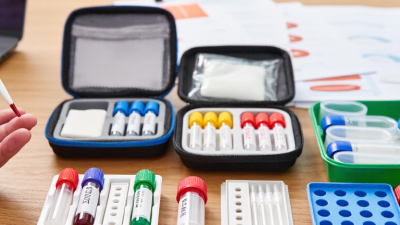
A blood test kit converts a small sample into a measurable signal. Depending on its design, it may use a finger-prick drop or blood collected into a tube. A lancet collects capillary blood; a strip or cartridge combines the sample with reagents. The reaction may appear as a colored line or a reading on a small device. Some kits measure glucose; others screen for specific markers. Not every kit works the same way.

The WHO Global Hepatitis Report 2024 estimates that 254 million people lived with hepatitis B in 2022, alongside 50 million with hepatitis C. These figures underline the value of accessible screening, but a screening result is not always a diagnosis. Some reactive results require follow-up testing in a laboratory. Buyers should review the intended sample type, storage conditions, expiry date, instructions, and performance evidence for the intended users. A neat package alone proves little.

Tips: Check the required sample volume and reading time before use. Keep the instructions nearby. A faint line can be misread, especially under poor lighting or after the stated reading window. Ask for validation data, too.

What Blood Test Kits Measure: Approximate Blood Composition

Blood test kits collect a blood sample for analysis. Depending on the test, the sample may be examined as whole blood or processed to separate plasma or serum. Whole blood is approximately 55% plasma and 45% formed elements by volume; formed elements include red blood cells, white blood cells, and platelets. Actual proportions vary between individuals.

Main Types of Blood Test Kits Made in China

Chinese-made blood test kits cover several distinct workflows, not one interchangeable product category. Common types include glucose and HbA1c tests, complete blood count (CBC) reagents, coagulation assays, blood grouping systems, and rapid infectious-disease screening tests. Some use finger-prick samples; others require venous blood, analyzers, or trained operators. That difference matters.

The WHO’s 2024 diabetes fact sheet reports 830 million people living with diabetes in 2022. This helps explain demand for glucose and HbA1c testing.

The International Diabetes Federation’s 2021 Diabetes Atlas estimated that 537 million adults aged 20–79 had diabetes in 2021, with 783 million projected by 2045. These estimates cover different years and populations, so they should not be compared as one continuous trend.

Buyers should check sample type, detection range, shelf life, storage temperature, controls, and analyzer compatibility against intended use. Ask for validation data and lot-to-lot consistency records, not just a broad accuracy claim. A low-cost kit can still disappoint. Packaging, translated instructions, and local service may be weaker than the assay itself; verify these details before ordering. Documentation deserves equal scrutiny.

Key Criteria for Comparing Kits for Global Markets

For global buyers, compare blood test kits by intended use, sample type, and evidence—not price alone. A finger-prick kit and a venous-blood kit can differ in collection steps, shipping needs, and user training. Check performance data for the exact specimen and testing setting. Ask whether studies include the populations and conditions relevant to your market. Small details matter.

The Lancet Global Health Commission on diagnostics reported in 2021 that 47% of the world’s population had little or no access to diagnostics. That access gap makes usability and dependable supply important, but it does not prove any kit is suitable. Review sensitivity, specificity, measurement range, and limitations in the product’s technical documentation. Look for independent evaluation where available. A polished spec sheet is not proof.

Shipping conditions deserve close review. Request stability data, temperature limits, shelf life, and clear instructions for sample handling. ISO 23640:2015 covers stability evaluation for in vitro diagnostic reagents; ISO 15189:2022 sets quality requirements for medical laboratories. They serve different purposes. Compare documentation, rather than treating either standard as a blanket product endorsement. Also check labeling, translations, local registration needs, and after-sales support. This is easy to overlook. One imperfect point: no single score captures every market’s needs.

Quality Standards and Regulatory Requirements

Best Blood Test Kits from China for Global Buyers

Quality standards and regulatory requirements should guide every purchase decision. A low unit price means little if the kit cannot be legally supplied or reliably used in the destination market. Buyers should confirm the product’s intended use, sample type, testing method, and user population. A finger-prick glucose meter, for example, may face different requirements from a laboratory assay. Details matter.

Request current quality-system evidence, such as ISO 13485 certification, and verify its scope and validity with the issuing body. Ask for performance data covering accuracy, precision, detection limits, and interference from common substances. Review lot-release records, stability results, and packaging integrity. A cracked lancet seal or unclear expiry date can undermine an otherwise sound test. Certificates alone do not prove that a specific kit performs as claimed.

Requirements vary by market. European buyers should check applicable IVDR obligations, while U.S. buyers should confirm the relevant FDA pathway and product status. Other countries may require local registration, an authorized representative, or importer documentation. Labels and instructions may need local languages, clear warnings, and validated storage limits. Ask who maintains post-market complaint records and handles recalls. Paperwork can lag. Even careful teams can overlook a local rule when shipment deadlines press; independent regulatory review is worth the extra time.

How Global Buyers Can Evaluate Chinese Suppliers

Choosing a Chinese blood-test-kit supplier requires more than comparing unit prices. Ask for the ISO 13485 certificate, then check that its scope covers the actual product and manufacturing site. Request performance data for the intended sample type, including sensitivity, specificity, and lot-to-lot consistency. Paper is not proof. Review the underlying reports, not only a polished product sheet.

Use independent benchmarks to frame your questions. WHO’s 2023 fourth edition of the Essential Diagnostics List includes 125 in vitro diagnostic tests. It is a useful reference for clinical needs, not a supplier approval list. WHO’s 2024 Global Hepatitis Report estimated that, by 2022, only 13% of people with hepatitis B and 36% with hepatitis C had been diagnosed. For relevant screening kits, ask how studies reflect real users, sample handling, and local disease prevalence.

Check traceability from raw materials to finished batches. Request a sample lot’s quality-control records, stability data, and transport conditions. A temperature logger in a test shipment can reveal problems that a brochure cannot. Verify certificates with the issuing body where possible, and arrange an independent evaluation before a large order. Even a detailed audit can miss practical weaknesses; unclear instructions or slow technical support may only appear during routine use. Small details matter.

Best Blood Test Kits from China for Global Buyers - How Global Buyers Can Evaluate Chinese Suppliers

Practical supplier-evaluation scorecard for blood-based in vitro diagnostic (IVD) kits

Evaluation Dimension Suggested Weight What Buyers Should Verify Useful Evidence to Request Potential Warning Sign
Regulatory status and intended market 20% Confirm the kit’s intended use, risk classification, labeling, and registration or conformity requirements for each destination market. Requirements differ by jurisdiction and product type. Current certificates and registrations where applicable; product labeling and instructions for use; declaration of conformity where applicable; documentation identifying the legal manufacturer and authorized representatives where required. A certificate is presented as proof of approval in every country, or the intended use and product identity do not match across documents.
Quality management system 15% Assess whether the manufacturer operates a controlled quality system appropriate to the product and target markets. ISO 13485 certification is useful evidence of a medical-device quality management system, but it is not by itself product authorization. Valid certificate and scope; recent audit information; documented change control, complaint handling, corrective and preventive action, and batch-release procedures. Certificate scope excludes the relevant manufacturing activity, or the supplier cannot explain how product changes and complaints are controlled.
Analytical and clinical performance 20% Evaluate performance for the specific assay and intended use, including precision, sensitivity, specificity, measuring range, interference, and relevant clinical performance. Acceptance criteria should be appropriate to the assay; there is no single threshold suitable for every blood test. Validation or performance-evaluation reports; study protocols and sample counts; comparison method details; precision and interference data; disclosed limitations and intended-use population. Only promotional summaries are available, or performance claims cannot be linked to the exact kit, instrument, specimen type, and intended use being offered.
Specimen and workflow compatibility 10% Check whether the kit supports the required specimen, such as serum, plasma, or whole blood, and whether collection tubes, sample volume, storage, and handling fit the buyer’s workflow. Instructions for use; specimen stability and handling data; minimum sample-volume specifications; compatibility information for required instruments and accessories. The supplier gives inconsistent specimen requirements or cannot substantiate claimed storage and transport conditions.
Batch consistency and quality control 10% Determine how each production lot is released and how the kit’s controls, calibrators, and acceptance criteria support routine quality checks. Representative lot-release records; certificates of analysis where applicable; control and calibration instructions; procedures for investigating out-of-specification results. No lot-specific records are available, or control materials and acceptance criteria are not clearly described.
Manufacturing capacity and traceability 10% Confirm the actual manufacturing site, production capacity, lot traceability, and ability to maintain supply at the required order volume. Facility details; production and lead-time information; lot coding examples; traceability and recall procedures; documented subcontracting arrangements, if any. The seller cannot identify the manufacturing site or clarify which production steps are outsourced.
Packaging, shelf life, and shipping 5% Verify the validated storage range, remaining shelf life at delivery, packaging integrity, and any temperature-control needs during international transport. Stability data; packaging specifications; shipping and temperature-excursion procedures; agreed minimum remaining shelf life on arrival. Shelf-life claims are not supported by stability information, or transport conditions are undefined.
Documentation, support, and commercial terms 10% Assess document completeness, language support, technical training, complaint response, minimum order quantities, lead times, and warranty or replacement terms. Document index; sample technical-support response; training plan; written quotation; delivery schedule; quality agreement and complaint-escalation process. Important terms are verbal only, or technical and post-sale support responsibilities are unclear.
Total suggested weight: 100% Weights are an adaptable buyer scorecard, not a regulatory standard or a ranking of specific suppliers.

Buyer note: Verify certificates and product claims with the issuing authority or relevant market regulator. Assess each kit against its exact intended use and destination-market requirements before purchase.