Top In Vitro Diagnostic Methods Revolutionizing Healthcare Today?
The advancements in In Vitro Diagnostic (IVD) methods are transforming healthcare delivery. According to a recent report by Grand View Research, the global IVD market was valued at $75 billion in 2022 and is expected to grow significantly. These methods enhance disease detection and monitoring. They help doctors make informed decisions quicker than ever before.
Dr. Alice Thompson, an expert in diagnostic technologies, emphasizes, "In Vitro Diagnostics are at the forefront of personalized medicine." This approach allows for tailored treatments and improved patient outcomes. Yet, with rapid innovation, challenges remain. Data management and integration of new technologies must evolve to keep pace.
Moreover, the high cost of advanced IVD solutions can limit accessibility. Disparities exist, particularly in developing regions. Ensuring equitable access to these innovations is a pressing concern that requires ongoing attention. The promise and challenges of In Vitro Diagnostics must coexist in today’s healthcare landscape.

Current Landscape of In Vitro Diagnostic Methods in Healthcare
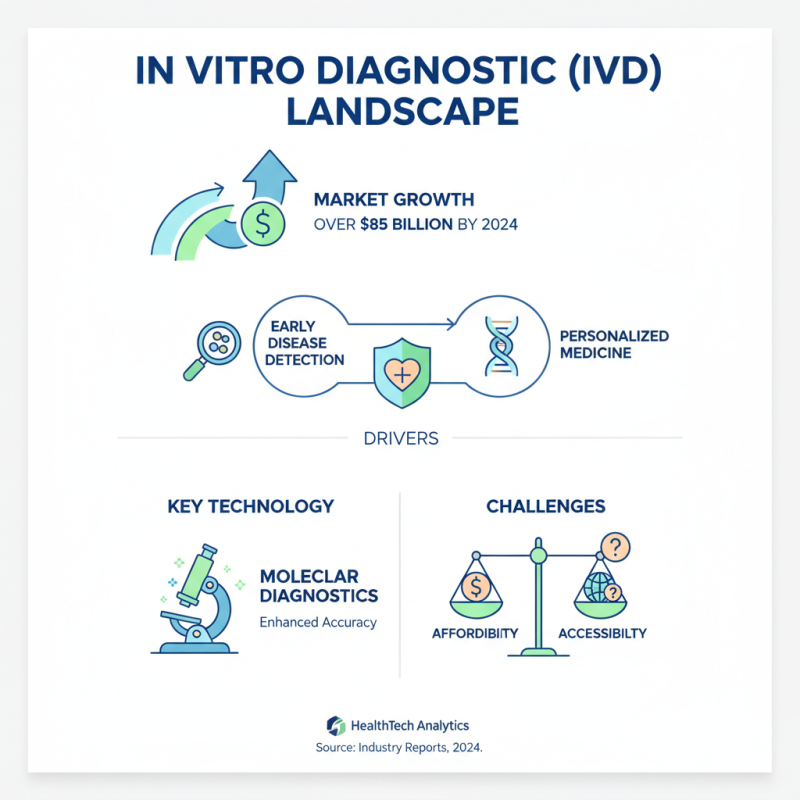
The current landscape of in vitro diagnostic (IVD) methods showcases significant advancements that are transforming healthcare. Reports indicate that the global IVD market is projected to reach over $85 billion by 2024. This growth is driven by the increasing demand for early disease detection and personalized medicine. Technologies like molecular diagnostics are making strides. They enhance the accuracy of pathogen detection, but they also raise questions about accessibility and affordability.
Point-of-care testing (POCT) is another area gaining momentum. It allows rapid and accurate testing directly at the patient’s location. A study revealed that POCT can reduce turnaround times by up to 80%. However, the reliance on these portable methods may overlook the necessity for comprehensive laboratory support. While POCT has its benefits, it can sometimes lead to inconsistent results without standardization.
Despite these innovations, challenges remain. Regulatory hurdles can delay the introduction of new tests. Data privacy issues also emerge as more tests rely on digital platforms. With all these advancements, it’s essential to reflect on their implications. Are we achieving equality in healthcare access? Is the focus on technology overshadowing patient-centered care? The answers lie in how stakeholders address these questions while pushing forward.
Key Technological Advancements Driving In Vitro Diagnostics
In the rapidly evolving landscape of healthcare, in vitro diagnostic (IVD) methods are at the forefront. Recent reports indicate a projected growth rate of 7.5% for the global IVD market, potentially reaching $87 billion by 2025. Key technological advancements are driving this growth and shaping the future of patient care.
One significant advancement is the rise of molecular diagnostics. This method enables faster and more accurate disease detection, often at the genetic level. With a rise in precision medicine, tailored treatments are becoming more common. However, access to these technologies can be unequal. Many patients still lack timely resources.
Another notable development is point-of-care testing (POCT). This approach allows for immediate results at the patient's location, improving care efficiency. The convenience is undeniable, yet accuracy can sometimes suffer in less controlled environments. Achieving a balance between speed and reliability remains a challenge for manufacturers and healthcare providers alike. As technology progresses, addressing these disparities is crucial.
Major Types of In Vitro Diagnostic Tests and Their Applications
In recent years, in vitro diagnostic (IVD) tests have transformed healthcare with their accuracy and efficiency. These tests play a crucial role in disease detection and management. For instance, molecular diagnostics, a major type of IVD, facilitate early identification of genetic disorders. Reports indicate that the global molecular diagnostics market is expected to reach $11 billion by 2025, highlighting its growing importance in healthcare.
Another prominent category is immunodiagnostics. These tests often assess diseases by measuring specific antibodies in the body. They are essential in managing conditions like autoimmune diseases and infectious diseases. According to industry analysts, immunodiagnostic testing accounts for more than 40% of the total IVD market share. However, the widespread use of these tests raises concerns. False positives and negatives can lead to misdiagnosis.
Point-of-care testing (POCT) is also gaining traction. POCT allows immediate results, which is crucial in emergency situations. It covers various applications ranging from glucose monitoring to infectious disease testing. Despite its advantages, the reliability of POCT can vary, raising questions about standardization. Each test must ensure accuracy, as errors could have significant health implications. As the field evolves, continuous improvement is essential to maximize the potential of IVD methodologies.
Impact of In Vitro Diagnostics on Disease Management and Prevention
In vitro diagnostics (IVD) play a crucial role in managing and preventing diseases. These methods include blood tests and molecular diagnostics. According to a report by Grand View Research, the global IVD market was valued at approximately $75 billion in 2021 and is expected to surpass $100 billion by 2030. This growth highlights the increasing reliance on accurate testing for early disease detection.
Effective disease management depends on timely and precise diagnostics. For instance, tests for diabetes and cardiovascular diseases have transformed patient care. Early detection leads to better treatment plans and improved patient outcomes.
However, there are concerns about accessibility. Not all patients can afford advanced testing, leading to inequities in healthcare.
Moreover, the rise of telemedicine has shifted how diagnostics are utilized. Patients now seek remote consultations, impacting traditional testing methods. While many benefit from this convenience, gaps remain. Some patients may not have access to recommended tests, which can hinder effective disease management. Ensuring that everyone receives proper care is vital for advancing public health.
Future Trends and Challenges in In Vitro Diagnostic Technologies
In vitro diagnostic (IVD) technologies are changing healthcare dramatically. According to a recent report by Grand View Research, the global IVD market is expected to reach $110 billion by 2025. This growth highlights the critical role of diagnostics in disease management. Early detection of diseases, especially cancers and infectious diseases, saves lives. However, challenges remain.
One significant challenge is ensuring accuracy and reliability. False positives can lead to unnecessary anxiety and treatment. Conversely, false negatives may delay crucial care. Data from the World Health Organization reveals that up to 30% of test results can be inaccurate. This inconsistency emphasizes the need for stringent quality controls and standardized procedures in diagnostic testing.
As IVD technologies advance, integrating artificial intelligence offers promising improvements. AI can enhance data interpretation, potentially reducing errors and increasing efficiency. However, it poses ethical questions. Data privacy and algorithm bias are notable concerns that require attention. Increased collaboration between regulators and technology developers is essential to address these hurdles for effective implementation. The future of IVD is bright, but it must navigate these complexities to realize its full potential.
Top In Vitro Diagnostic Methods Revolutionizing Healthcare Today
| Diagnostic Method |
Application |
Advantages |
Challenges |
| PCR (Polymerase Chain Reaction) |
Infectious Disease Detection |
High sensitivity and specificity |
Contamination risk and complex protocols |
| ELISA (Enzyme-Linked Immunosorbent Assay) |
Hormone and Protein Detection |
Cost-effective and easy to perform |
Limited to specific antibodies |
| Lateral Flow Assays |
Rapid Testing for Various Conditions |
Portability and quick results |
Lower sensitivity compared to more complex methods |
| Next-Generation Sequencing |
Genetic Testing |
Comprehensive genomic information |
High cost and data management challenges |
| Microfluidics |
Point-of-Care Testing |
Minimized sample volume and faster results |
Technical complexity and manufacturing hurdles |

 +86-18343147735
 Email
Email WhatsApp